

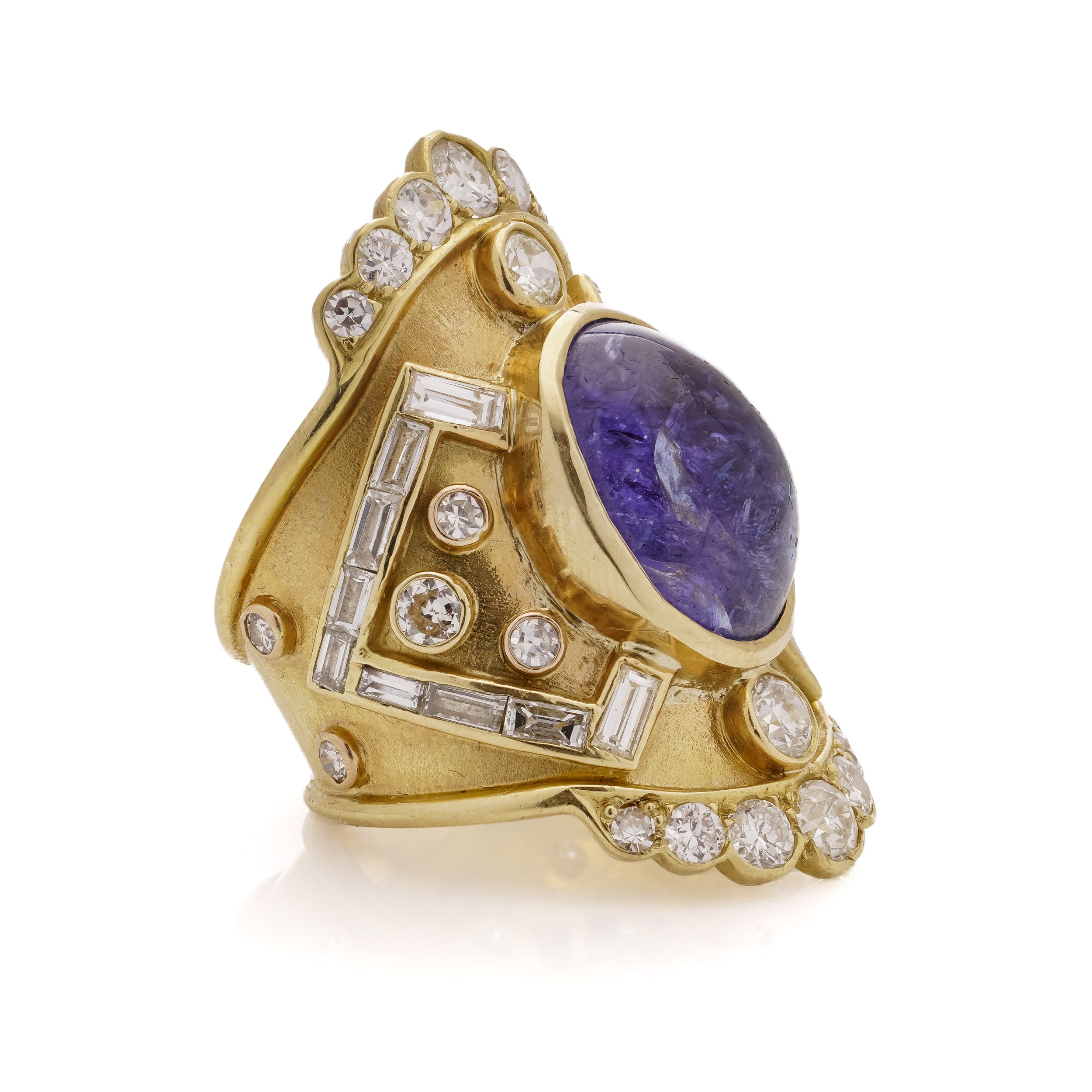
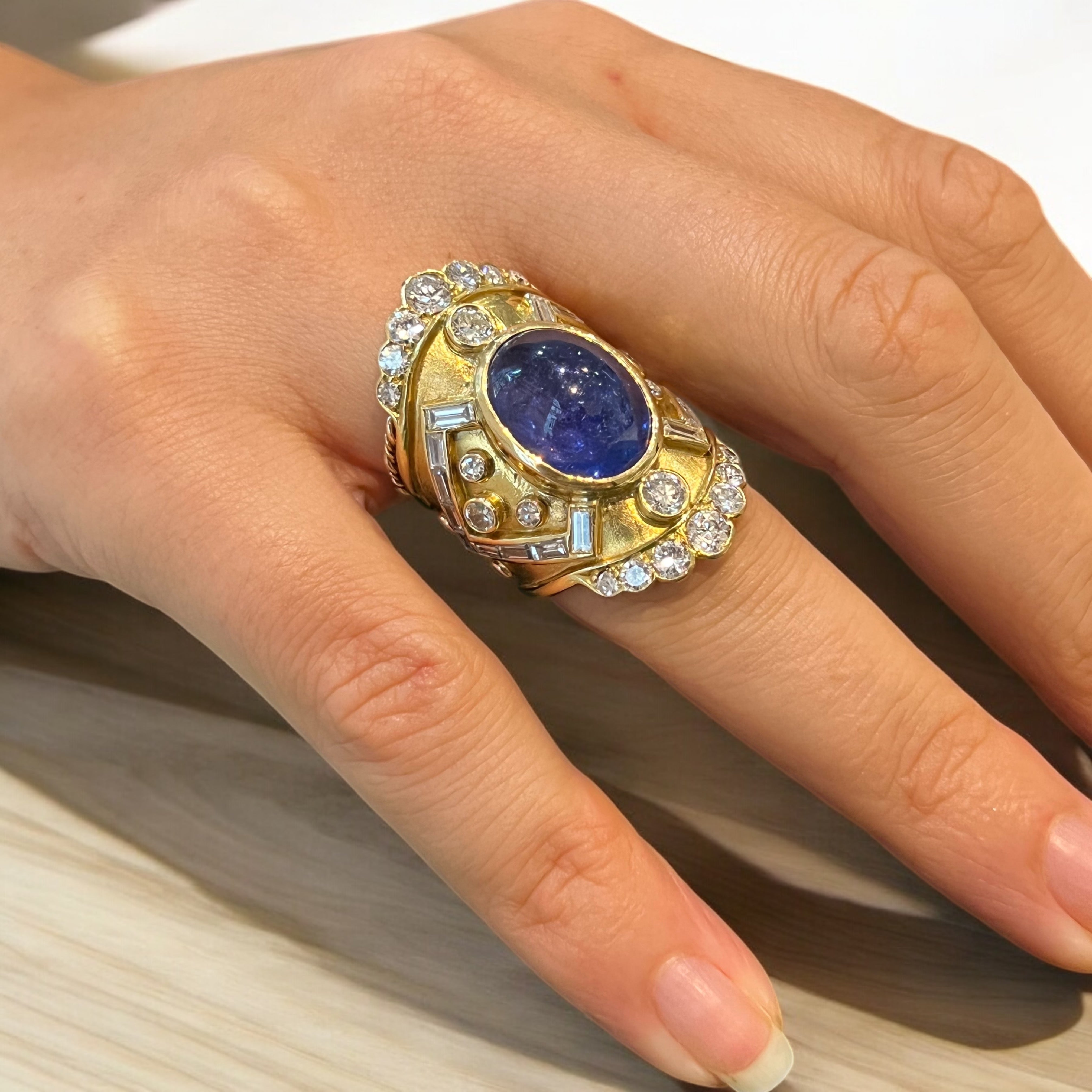
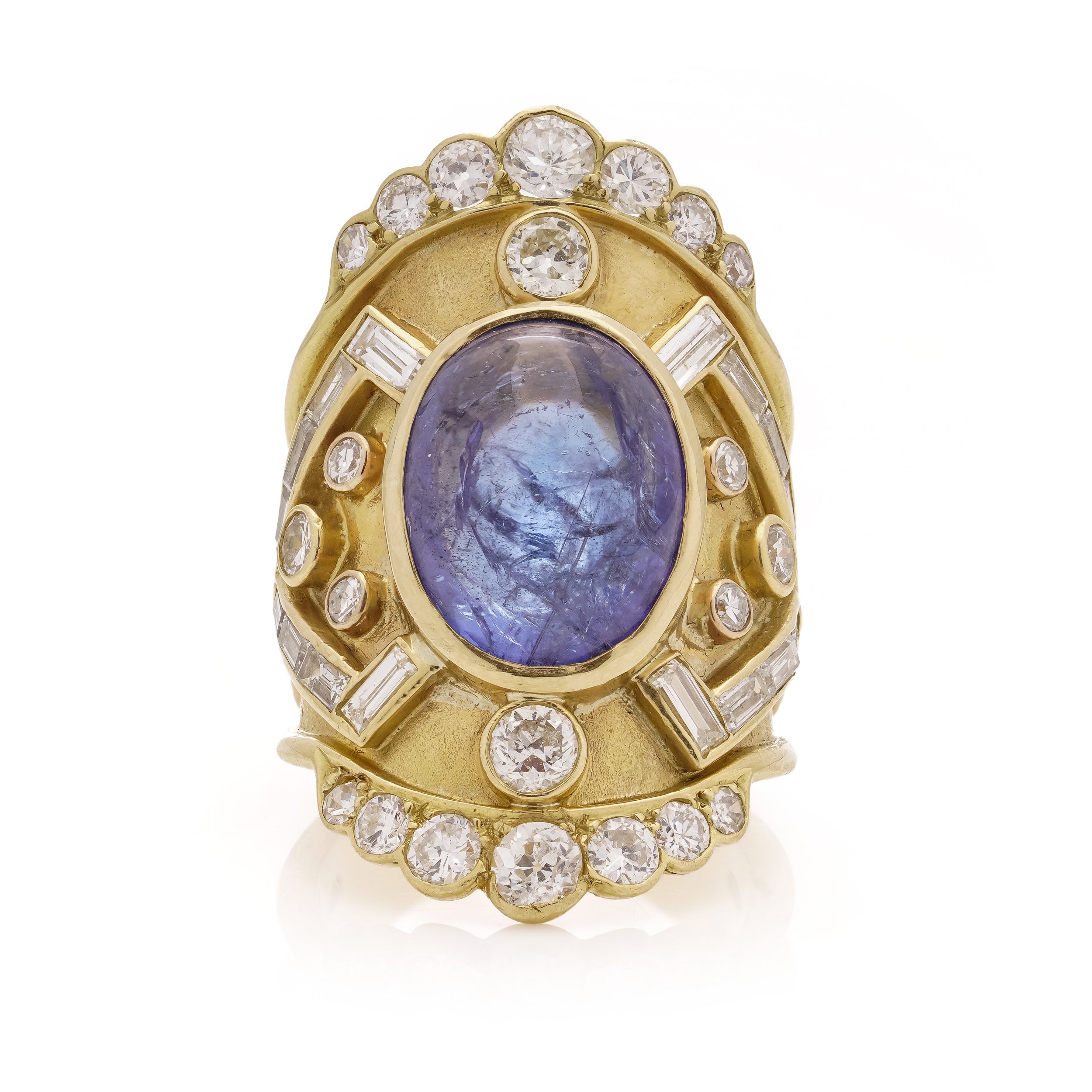
Tanzanite is among the rarest gemstones in the world — found in a single geological deposit at the foot of Mount Kilimanjaro in Tanzania, where it was discovered in 1967, and nowhere else on earth. Its defining quality is trichroism: depending on the angle of the light, the stone shifts between deep blue, violet, and burgundy, a depth and complexity of colour that no other blue stone can replicate. The cabochon at the centre of this ring is an estimated 12 carats, its domed surface allowing the full range of the stone's colour to move as the hand moves.
The ring is made in the Etruscan Revival style — a historicist movement inspired by the archaeological rediscovery of ancient Etruscan goldwork in 19th-century Italy, characterised by bold, sculptural forms, granulation, and wirework. The style enjoyed a significant revival in the jewellery of the 1970s and 1980s, when the taste for statement pieces found a natural affinity with its emphasis on scale and presence. This ring, c.1980, is a strong example of that revival: substantial, architectural, and made to be noticed.
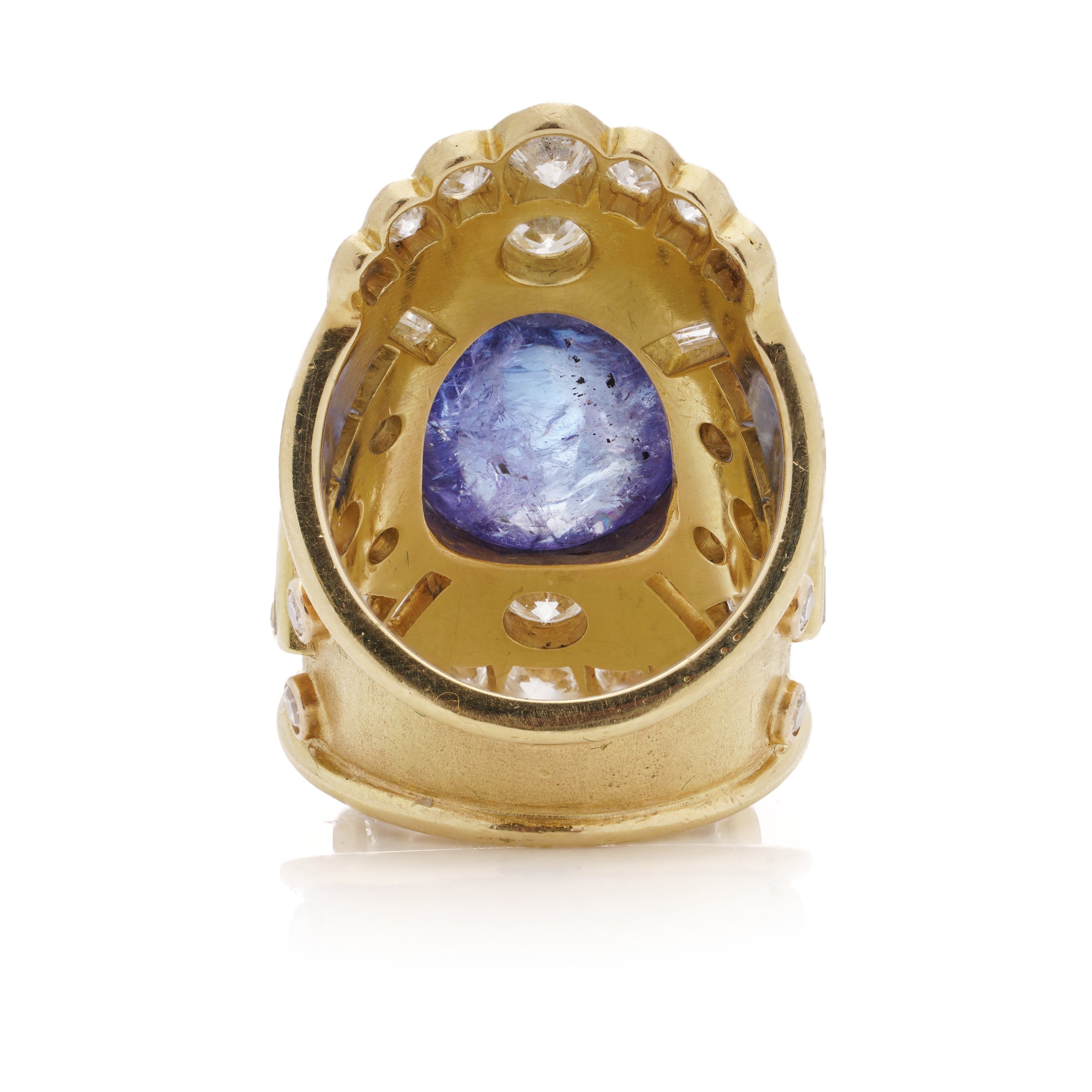
The tanzanite is set in a rub-over gold setting at the centre of the mount, with a band set all around with a mixture of brilliant-cut and baguette-cut diamonds. At 19.5g and size O–P (UK) it is a ring of commanding weight and presence. Tests as 18ct gold.
The Details
- Circa: 1980
- Weight: 19.5g
- Ring size: O–P (UK)
- Tanzanite: Cabochon, estimated 12 carats
- Diamonds: Brilliant-cut and baguette, set all around the band
- Hallmarks: Tests as 18ct gold
- Style: Etruscan Revival
18ct Gold Etruscan Revival Tanzanite & Diamond Ring, c.1980
促銷價£7,500.00 GBP
原價
選擇選項
18ct Gold Etruscan Revival Tanzanite & Diamond Ring, c.1980
促銷價£7,500.00 GBP

